How do I roll AI out to my team?
AI for Managers
Your company bought licenses. Someone sent the launch email. A few people are enthusiastic, most tried it twice, and you are now the person expected to make something happen.
Everything here is for a manager of roughly 5 to 30 people, with no technical background assumed. Start with the toolkit if you want the whole method; read the articles if you want the argument behind a particular piece of it.
Start here
The Manager's AI Toolkit
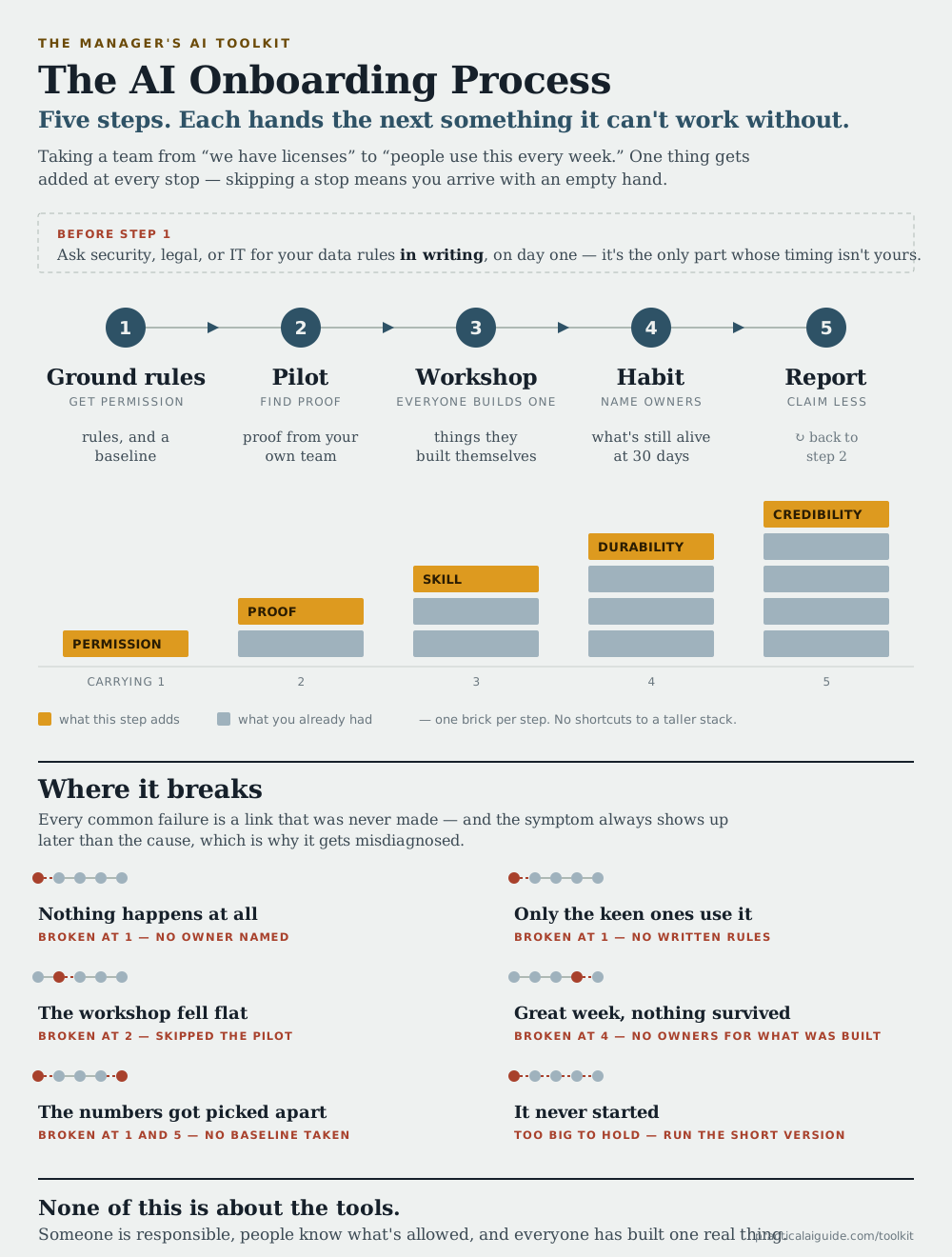
The complete method, free and without a signup: five guides that read in order, nine working documents you fill in and hand out, and a worked example with every template already completed for one (invented) team.
- Setting the ground rules — who owns it, and getting your data rules in writing
- Running a small pilot — two or three people, not the team
- Hosting a workshop — everyone builds one real thing
- Making it stick — owners, measurement, skeptics
 The process, on one page →
The articles
Shorter than the toolkit and standalone. Each one is the argument behind a decision the toolkit asks you to make.
Why rollouts fail
Read one of these if you want to know what you are walking into. They are the diagnosis, not the treatment.
- Why Most Workplace AI Rollouts Quietly Fail, and What the Winners Do Differently
Only about one in five corporate AI investments delivers a measurable return, and just one in fifty is transformational, yet AI tops the CEO priority list. Here's what separates the rollouts that work.
- Who Owns AI Adoption? When It's Everyone's Job, It's Nobody's
47% of U.S. employees say their company has integrated AI, but only 15% use it daily. That gap isn't a training problem or a tool problem. It's an ownership vacuum, and there's a two-hour-a-week fix.
- Buying AI Tools Isn't Adopting AI, and the Bill Comes Due Later
Over 80% of enterprise AI projects fail, twice the rate of normal IT projects, and it's almost never the technology. It's that companies buy the licenses and skip the training. Here's the gap, and what the survivors do differently.
Doing it
The two concrete moves, in order: publish the rules, then get everyone to build one thing.
- Write a One-Page AI Policy Your Team Will Actually Follow
Most workplace AI policies are either nonexistent or a twelve-page legal document nobody reads. Here's the short version that covers what actually matters.
- AI Workshop in Three Hours: You Won't Get a Day and a Half
A short AI workshop where everyone builds one real thing, the agenda, why each block is that long, and the fifteen minutes of scope-cutting that decides whether it works.
Once it is running
What to measure without overclaiming, and the change nobody gets to once the tools are in.
- AI Productivity Gains: Everyone's Using It, Almost No One Is Saving Time
Around 91% of businesses now use AI in some form, yet the average worker reclaims only about 5% of their week from it. The gap between using AI and actually getting time back is the whole story.
- AI Role Redesign: Every Job Is Changing, Almost No One Is Rewriting Them
Executives overwhelmingly say AI is reshaping their roles, yet when a seat opens, only about 1 in 11 organizations actually rethinks the job before filling it. That gap is a quiet, fixable mistake, at every level.
More
- Building an AI Culture: Your Systems Count Twice as Much as Their Mindset
Microsoft measured 29 factors against reported AI impact across 19,854 people. Culture, manager support and talent practices explained 67% of it. Individual mindset explained 32%.
- How to Review Your Team's AI Work (Even When They Hide It)
77% of workers scrutinize a colleague's work more closely when they know AI was involved. The load-bearing words are 'when they know.' A review method that doesn't depend on being told.
- Why People Resist AI at Work: It Threatens What They Are Good At
The most-quoted stat about failed AI projects lists data quality, cost and unclear value. It does not list people. Research on why that omission matters.
- Your Team Is Building AI Tools After Hours. That's a Management Failure.
I gave my team AI training, tools and encouragement. Someone still built the useful thing on their own time, because I never said it counted as work.
- Who Is Responsible When AI Gets It Wrong at Work? Not the Vendor
Courts have sanctioned hundreds of professionals over AI-fabricated work. What they were punished for is the useful part, and it is not the mistake.
- AI Mistakes at Work: Run a 30-Minute Post-Mortem, Not a Witch Hunt
One in four executives says an AI error has already reached outsiders or the board, and 84% are confident in AI output without human review. Here's the half-hour review that turns one mistake into a fix instead of a rumour.
- AI Productivity Paradox: Your Team Feels Faster and the Company Can't Tell
65% of workers say AI improved their productivity. 89% of executives say it has had no effect on theirs. Both surveys are sound: the gains are real and they're getting absorbed before they reach anything you can measure.
- How to Run an AI Pilot: Aim for Evidence, Not Proof
One widely-quoted study says 95% of AI pilots fail. Another says 48% reach production. They disagree because they're measuring something you probably shouldn't be attempting, and the pilot that actually works has a different goal.
- Measuring AI Adoption: Why Token Counts Went the Way of Lines of Code
For one spring, some companies treated heavy AI usage as proof of a high performer. By summer the bills arrived and the idea collapsed. The mistake underneath it is older than AI, and you're going to be offered it again.
- How to Rewrite a Job Description for AI: Tasks First, Not the Title
Most role redesigns fail because they start with the whole job. Google's data says AI touches about a fifth of the tasks in a typical role, so that fifth is what you rewrite. Here's the procedure, and the before-and-after description it produces.
- How to Train Your Team on AI: Why the Course Isn't Working
85% of employees say their AI training doesn't help them use AI in their actual role, and it isn't because companies aren't training. Gallup found the thing that moves usage isn't the course at all.